Showing posts with label Math. Show all posts

Monday, September 22, 2008

What's in a hand, and other units of linear measure

You can lay out your lesson plans as carefully as you want ~ how the student responds is a great unknown...

The Post Office Project continues with its study of time.  Papa Gardener and I decided to make linear measure the next math subject.   We agreed that S would start off by reading the story of Noah and the Ark.  This would be followed by exploration of various measurement units.

He read the story to himself, and also to T., using Tomie dePaola's "Stories of the Old Testament.  Then, the idea was to start measuring things with hands, and feet, and cubits, and to see that using individual people's measurements led to inconsistent results.  Well, no sooner did Papa Gardener and S begin, S announced that it would really be better to use a standardized unit.  They continued their exercise anyway, finding that the kitchen table, for example, was 4 of S's cubits in length.  That was remeasured in inches, and then they figured out how long each of those cubits was in inches.  And so on...

For a comparison of units, they headed outside to our supersized chalkboard, also known as the asphalt driveway.  The centimeter just barely shows up in the photo!

This lesson was supposed to stretch over several days.  Both teacher and pupil got so involved in it that they kept at it for several hours, accomplishing the lesson in one day.  Oops!  On the other hand, that's a perk of homeschooling... no need to shoehorn the lesson into the alloted time space when you find yourself on a roll!

Sunday, September 21, 2008

A little cubit research

This weekend was -- finally! -- *the* weekend for making a more detailed draft for guiding us through Grade 3 this year.

S has already started on some measurement.  In fact, he's got an interesting data collection project going right now.  It's a sort of "applied time" thing.  Perhaps more on that another time...

Tomorrow, he'll start off some work using biblical measurements.  Here are some links I found regarding cubits:

(For a bonus, here's a link about Abraham, to get a jump on those Old Testment blocks.)

Saturday, May 10, 2008

Multiplication tables are more fun with a clock!

I'm in catch-up mode today... This photo is actually from early Winter...

Learning the multiplication tables was one of our goals for Grade 2. Once I learned about Robinsunne's Multiplication Clock, I knew S had to make one of these! The problem was that I was more enthusiastic about the concept than he was. Together, we persevered.

One learning we soon made was that there's a reason that your paper should be large: if, just hypothetically speaking, of course, you use an 8.5" x 11" sheet, your circles and numbers get awfully crowded. This is especially true for still-emerging writers, whose handwriting is big.

Also, despite mothers' advice to the contrary, permanent markers are exciting to use, but they bleed into the paper, causing the numbers to run together. When this occurs well into the project, you either start over (not a popular suggestion), or you find an alternate solution. In this case, that solution was to White-Out the problem, to photocopy the page, and then to rewrite what's needed [using something other than a permanent marker ;-) ].

To extend the lesson, S circled all of the square numbers - this is difficult to see in the image below, however. He discovered that the circles form a spiral. Neat!

multiplication clock

Sunday, June 03, 2007

Multiples are more fun to learn in the sandbox than with tables

I'm preparing for our County homeschool review, scheduled for later this week. This has me looking over what we've done this semester (and realizing how much I intended to post here but haven't... watch more for catch-up!...)

In early May, I saw how other families had used math boards to work on learning their multiplication tables. How much more fun than sitting there, memorizing facts from tables on a piece of paper!

We have ample scrap wood in the garage, and nails as well. I wondered, however, whether our sandbox might serve us for a temporary "math board" ...

While the boys were playing in the backyard, I found a long twig, and broke it into smaller pieces. I smoothed out an area of sand, and then arranged 10 pieces in a circle. I cut 10 small pieces of paper. Then, I invited S to come over and write the numbers 0 through 9 on the papers. Carefully, we poked a hole into each paper, and stuck it onto a twig piece. We then tied a length of yard to the "0" twig, and let the fun begin!

Counting by 4's created a 5-pointed star!


Here, we switched yarn colors...
Counting by 3's created something that looks more like a sun!


When we wrapped up, we added the twigs and paper slips to the compost pile.

Monday, March 26, 2007

Manipulating multiples, or finding math in everyday life

So, somehow I was roped into organizing a large-ish community event. Yes, this is as much of an undertaking as it sounds. Thankfully, it's for an organization our family values highly. I'll leave the back story to the fertile imaginations of you Gentle Readers. Last Thursday's project: publicity.

We had one ream of paper printed up with bookmarks. S and I biked over to pick this up, and then headed over to the organization's building to use their paper cutter. We moved the paper cutter to the floor, talked about how to use it safely (fingers nowhere NEAR the blade!!!), and cut... and cut... and cut... and cut.

While there, we raised a few eyebrows. (Shouldn't you be in school? Um, no, we're homeschooling. Oh.) Little did our questioners know that we had quite a math lesson while seated there on the floor, surrounded by many, many sheets of bright yellow paper.
  • The copy center gave us our print job in two boxes (2 x 250 sheets = 500).
  • Each sheet had four bookmarks printed on it (4 x 500 = 2000).
  • One sheet yielded 4 bookmarks, 2 sheets gave 8, and so on, until we calculated out multiples of up to 4 x 12.
  • We experimented with how many sheets we could successfully cut at once. We decided that 6 sheets was the limit on that. In the meanwhile, we covered multiples of 1, 2, 3, 4, 5, and of course, 6.
  • Having settled on cutting sets of 6, we then worked with individual stacks of bookmarks: one cut gave us 6, 2 cuts --> 12, 3 cuts --> 18, and so on. A nearby cart had some puppets on it in preparation for a storytime. While I was cutting, S sampled the wares, settling on a little pig. To liven things up, I suggested that the bookmarks be snacks. So, the piggie was handed a stack of bookmarks after each cut, eagerly "gobbling" it up. I think S decided that 18 bookmarks was the pig's threshold for developing a tummy ache. :-)
Needless to say, we hardly noticed that we were at our work for a good two hours. The math "lesson" should prove to be fairly memorable! And, amazingly, no blood was shed, not even on an ordinary paper cut.

Friday, December 01, 2006

Celebrating the number 100!

If you include weekends (and really, on what day do you not have a learning experience? :-) ), yesterday was our 100th day of homeschooling. So, we've been celebrating the number 100!

First, I made a 10x10 square grid for S, and he wrote in the numbers from 1 to 100. He wasn't beyond the mid-20's when he started noting number patterns he saw emerging.

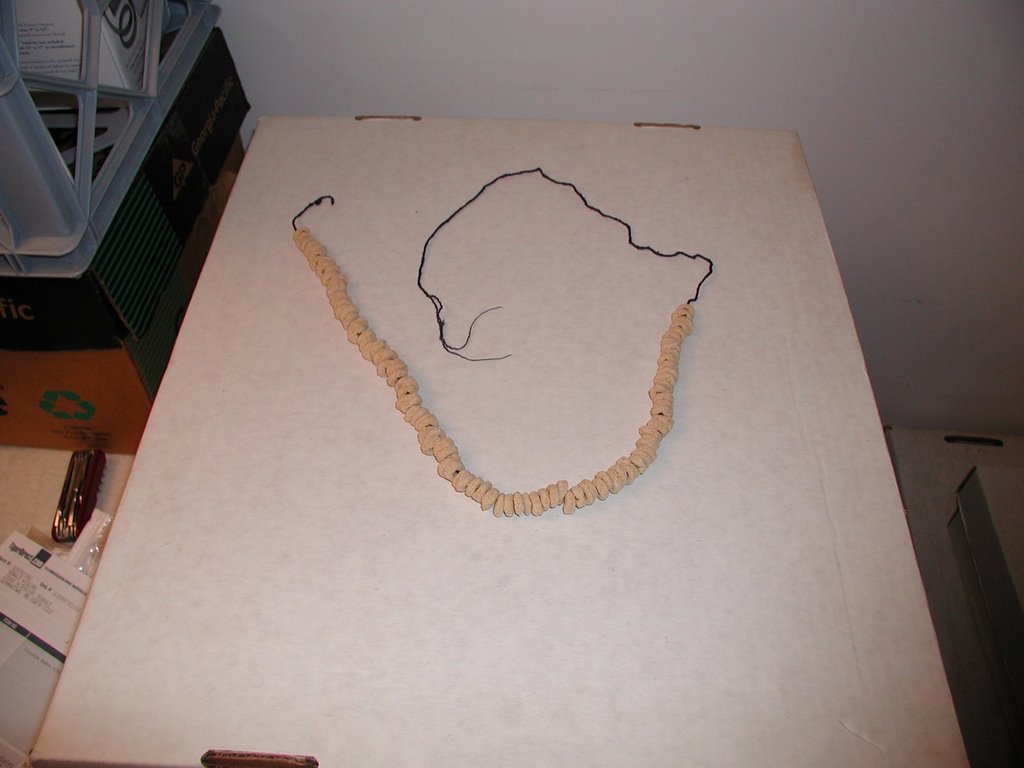
Have you ever wondered what 100 Cheerios look like on a 100 cm piece of yarn? (It's even more when you factor in the broken pieces which have to be eaten!)


In the afternoon, he estimated how far 100 steps would take him. Pretty far, as it turned out! He started at our mailbox, and ended up "across the big street!"

Tuesday, November 28, 2006

Collecting milk lids = a math lesson

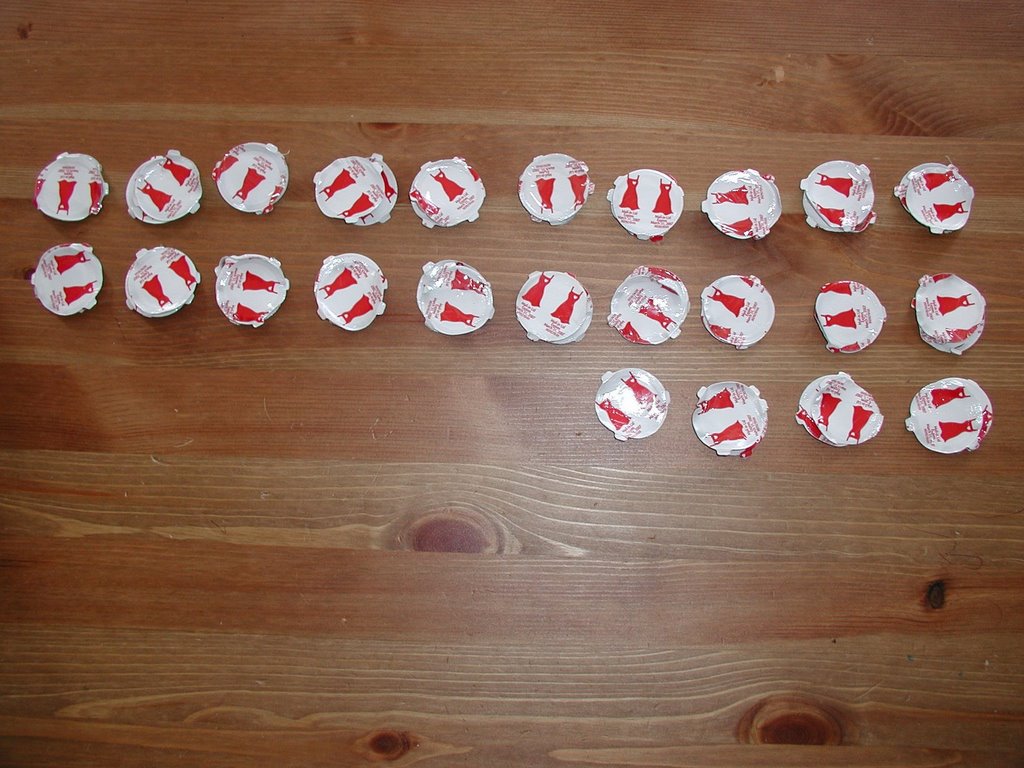
With help from the other soy milk drinkers in the family, we'd been collecting the Red Dress foil lids from 8th Continent Soymilk. The baggie was getting full, and in our Advent cleanup mode, it was time to get these lids on their way.

But, before sending them in, we wanted to know how much money 8th Continent would donate to women's heart disease awareness as a result of our efforts.

Well, said S, each one is worth 50 cents, so two are one dollar. He then made piles of two... for a total of 24 piles. Wow! We had $24!

Then, we wanted to know how many lids we had:

2 lids/pile x 20 piles = 40 lids.
2 lids/pile x 4 piles = 8 lids.
40 lids + 8 lids = 48 lids!

There was one more challenge: figuring out the combination of stamps needed to send the envelope on its way. That, too, accomplished, the intrepid lid counter set off to the post office...

Saturday, November 25, 2006

Here's a sampling of how our Number Book turned out

Cover page of Number Book


Three people:
the number 3

The four elements (fire, air, water, earth):
the number 4

Seven colors of the rainbow:
the number 7

A spider (8 legs) in her web:
the number 8

This became an elaborate story! It involved three witches, three princes (each wearing crowns with 3 points) who had money bags each holding 3 coins... So, getting to nine (and we did during the creation of this drawing!) involves using various combinations of multiples of 3...
the number 9

Here, S. did coin rubbings of 10 pennies, plus a dime,
and then drew the border containing 10 blocks...
the number 10

Tuesday, October 24, 2006

What's 5? A dandelion, of course!

We're continuing to work our way through our Qualities of Numbers block. Today we were on the question of "What is 5?"

Of course, I prepared! I came to our session thinking about 5 fingers, 5 toes, 5 senses, 5 points on a star...

S and I talked about these things. As he was considering what he'd draw for "5", he went to the window and looked outside for inspiration. He came back, and said that dandelions had 5, and that's what he'd draw. Dandelions?! Five?!

Why, yes. As he explained it, dandelions have five leaves. (At least the one he carefully drew does!). So do the clovers that he added to the picture, also with five leaves.

And here's what's so fascinating about being able to do this learning at home: Whether or not dandelions, as a rule, have five leaves is almost secondary. As S created his drawing, the very first thing he drew was the long taproot. (To emphasize the little root hairs, he went over them a second time with a darker color.) Where the heck did a taproot enter into this? Very easily. This morning, we volunteered (for a *very* cold hour in the icy wind, I might add) at our CSA. Our work included harvesting celariac. One celariac I pulled out of the ground came with a dandelion. Because the soil was so loose, the dandelion's taproot came out intact, and I pointed this out to S. We then talked a little about taproots. When S and I had our math lesson a few hours later (in the warmth of the sun coming in through the window), he reached back to what he'd seen at the farm, and brought that forward into his study of the number 5.

After his finished his drawing, I observed to S that he'd covered the whole page with his drawing and with color. He gave me a very matter-of-fact look, stopping just short of rolling his eyes. He said that yes, he had, just like I'd encouraged him to do before. It's true -- I had, but not today. :-)

Thursday, October 12, 2006

Number qualities: the power of One

As with form drawing, I was feeling guilty about falling "behind" in math, too. Even though S knows his numbers, I wanted to start him off with a block on the qualities of numbers. I reread Marsha Johnson's helpful article about this, and... off we went!

I wasn't too confident in my storytelling ability, but over dinner, did my best to retell Marsha's tale of embarking on a journey and ending up at the feet of an old woman who asked "What is one?" To my surprise, I had S's full attention -- the story speaks for itself, I guess, even when delivered by a rank novice.

S, never one to want to wait for a surprise, impatiently asked me how the story continued. "You'll find out tomorrow" didn't satisfy him. What finally did the trick was that I told him I needed to find out the answer myself, and that it would be given to my overnight as I slept!